
Listen to this Article
How different does a game have to be before it actually feels different?
That was the question I kept coming back to after spending some time with the D&D 2024 rules.I had heard about the changes. I knew there was a new Player’s Handbook. I knew classes had been revised, backgrounds worked differently, and there had been a lot of discussion about whether this was still fifth edition, 5.5e, or something sitting somewhere in between.
Then I actually sat down and created a character.
And for the most part?
It felt like D&D.
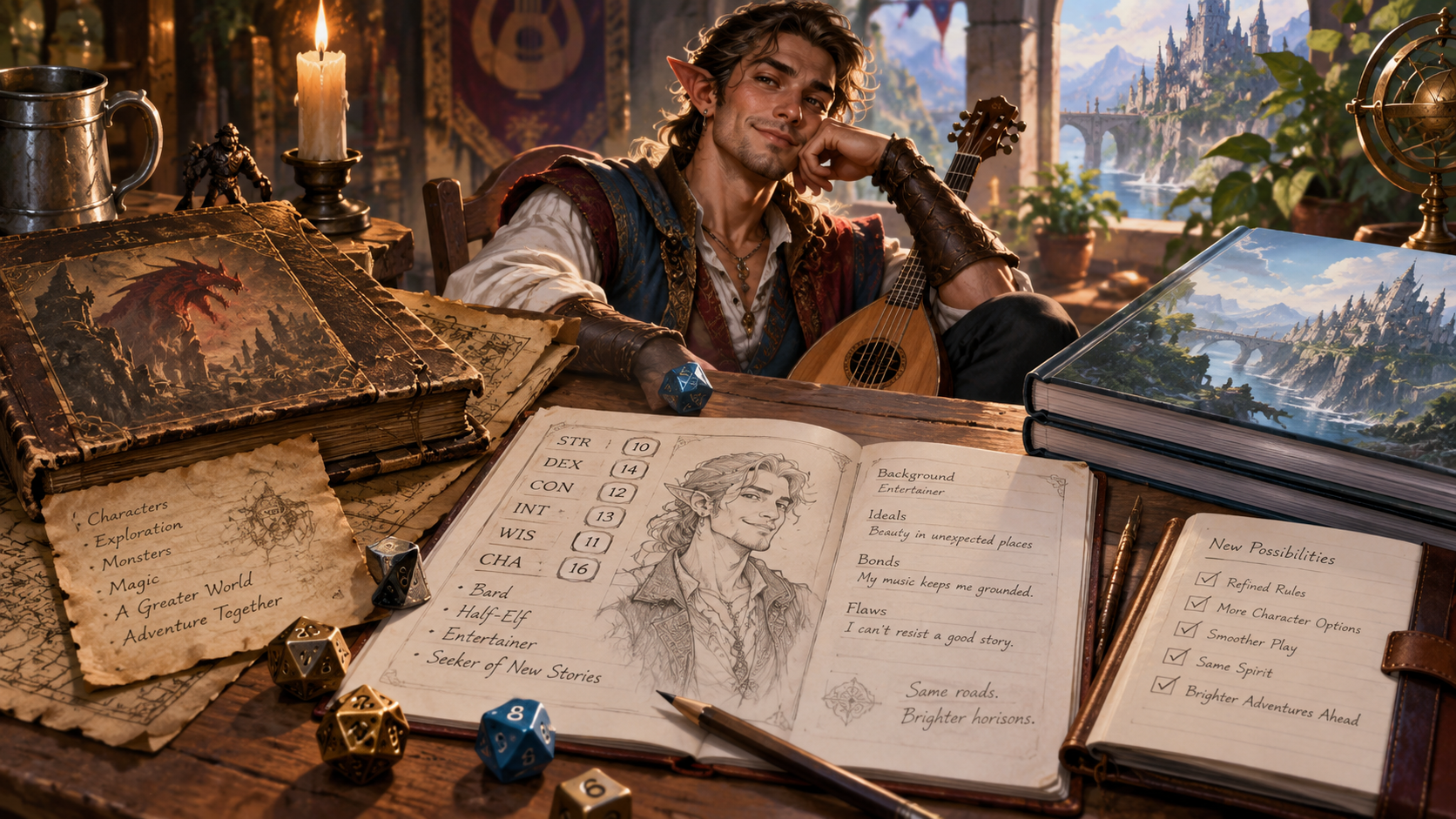
I made a male Elf Bard. I assigned the same familiar ability scores. I was looking at the same basic classes, Armor Class, Hit Points, proficiency bonuses, spells, skills, and saving throws I already knew.
Things had moved around. Some terminology had changed. There were obviously new rules hiding underneath everything.
But I never had that moment where I thought, “Okay, I need to forget what I know and learn D&D again.”
At least not at first.
Then I went looking for Half-Elf.
Wait… Where Is Half-Elf?
The character I had in mind was half human and half elf.
I have been around D&D long enough that “Half-Elf Bard” doesn’t exactly sound like an unusual character concept. So I naturally started looking for Half-Elf during character creation.
And couldn’t find it.
There was Elf. There was Human. There were the other revised species.
No Half-Elf.
That was probably the first moment where the new rules actually stopped me.
I eventually made the character mechanically an Elf and simply described him as having both human and elven heritage. It worked fine for what I wanted to do, and I moved on.
Except there was a little more going on here than I realized.
When I went back and researched the rules for this article, I discovered something important: Half-Elf isn’t actually gone from the game.
The revised Player’s Handbook does not contain a new Half-Elf species entry, but Wizards of the Coast specifically lists the 2014 Half-Elf—and Half-Orc—as older options that remain usable with the revised rules because they weren’t replaced by new versions. If you use one of those older species, you ignore its old ability-score increases and use the revised background rules for those increases instead.
So I could have used the old Half-Elf mechanics.
There is another wrinkle here that is worth clearing up because I think it has caused some confusion.
During the 2022 playtest for the revised rules, Wizards experimented with a general mixed-heritage system where you could choose parents from two different humanoid species, use the game traits of one of them, and describe your appearance as a combination of both.
That concept never became a general mixed-heritage rule in the final 2024 Player’s Handbook.
What I did—use Elf mechanically and describe the character as partly human—still works perfectly well as a character concept. But the rules did not force me to do it that way.
That distinction matters, especially when so much information from the playtest period is still floating around online.
It also helped answer another question for me.
Why did Half-Elf stand out so much when most of the other changes barely registered?
Because Half-Elf was something I went looking for and couldn’t find.
Many of the bigger mechanical changes don’t announce themselves that way.
You don’t notice that Surprise works differently until somebody gets surprised.
You don’t notice the new Exhaustion rules until someone becomes exhausted.
You don’t notice changes to Grappling until somebody grabs someone.
You don’t notice that healing spells have changed until somebody needs healing.
Half-Elf was visible immediately.
A lot of the more important changes are waiting for you at the table.
So What Are We Calling This Thing Now?
Before going much further, we should probably settle the terminology.
Or at least try.
When Wizards originally announced the revised core books, the company was very clear that these were updates to fifth edition, not a new sixth edition. Wizards specifically said that the revised core books were not “ushering in a new edition” and were designed to remain compatible with existing fifth-edition adventures and supplements.
For a while, everyone mostly called them the 2024 rules, 2024 D&D, or some variation of “revised fifth edition.”
Then D&D Beyond complicated—or perhaps simplified—things in March 2026 by officially adopting labels many players were already using:
5e now identifies the 2014 rules on D&D Beyond.
5.5e identifies the revised 2024 rules.
D&D Beyond is also very careful to say that this is a clarity label, not the declaration of a new edition. Both remain versions of fifth edition, and the label itself changed no rules.
For this article, I am going to mostly call them the 2024 rules because that makes the comparison fairly obvious. But if you see 5.5e on D&D Beyond now, that is what they are talking about.
And yes, I suspect we’ll be arguing over what to call editions of D&D for as long as there are editions of D&D.
Some traditions never change.
How the D&D 2024 Rules Changed Character Creation
One reason character creation still felt familiar to me is that the end result looks very familiar.
You still have Strength, Dexterity, Constitution, Intelligence, Wisdom, and Charisma.
You still choose a class.
You still choose the sort of fantasy character you want to be.
But the pieces underneath that process have been rearranged.
The revised rules describe your character’s origin as two major components: your background and your species. Your species provides things such as size, speed, creature type, and species-specific traits. Your background now carries considerably more mechanical weight than it did before.
A revised background provides ability-score choices, an Origin Feat, skill proficiencies, a tool proficiency, and starting equipment.
That is a pretty substantial change.
Under the original 2014 rules, your race generally supplied your ability-score bonuses. In the revised game, those bonuses are tied to background instead.
The word race itself has also been replaced by species. Wizards announced that change during development, explaining that it wanted to move away from the real-world baggage attached to the term “race” and had selected “species” in consultation with outside cultural consultants.
Whether or not that terminology is the first thing a player notices, mechanically I think the more significant change during character creation is what happened to backgrounds.
Backgrounds aren’t just a couple of skill proficiencies and a bit of character history anymore.
They are part of your build.
And every background gives you an Origin Feat, so feats are now part of a normal first-level character rather than something many characters might not encounter until later.
That is the sort of change I could easily move through during character creation without immediately appreciating how much it might affect a character over time.
My Bard Probably Made the Transition Look Easier
There is another reason I probably walked away thinking, “This really isn’t all that different.”
I made a Bard.
The revised Bard has changed, but its basic identity is very recognizable.
Bardic Inspiration is still Bardic Inspiration. Charisma is still the class’s central ability. You still have Jack of All Trades, Expertise, spellcasting, subclasses, and the general idea of a character who can fill several different roles depending on what the party needs.
Some of the revisions are genuinely nice.
Bardic Inspiration now lasts an hour instead of ten minutes, and the recipient can wait until after failing a D20 Test before deciding to use it. It can also be given to someone who can either hear or see the Bard, which opens the class up a little more for Bard concepts that aren’t built around music or speech. Expertise arrives earlier. Song of Rest is gone. Countercharm became much more practical, and later Bard abilities such as Magical Secrets received significant revisions.
There is even a new College of Dance subclass if you want your Bard’s performance style to involve considerably more kicking people in the face than mine probably will.
But none of those things make the Bard stop feeling like a Bard.
That matters.
Had I made a Fighter, Barbarian, Ranger, Rogue, or Paladin, I would have encountered Weapon Mastery, one of the most visible new combat systems, almost immediately.
Weapons now have mastery properties that characters with the appropriate feature can unlock. Depending on the weapon, these can let you do things such as push an enemy, knock someone prone, make an extra attack, move a Light-weapon attack into the Attack action, or even deal some damage on a miss.
My Bard wasn’t interacting with that system.
Had I built a Monk, Druid, or some of the other more extensively revised classes, my first impression might also have been very different.
In other words, my experience wasn’t wrong.
It was just one particular window into the revision.
The Bigger Differences Start Appearing When the Dice Hit the Table
This is where things get more interesting.
The basic D&D structure really hasn’t changed that much. You still roll a d20, add modifiers, try to hit Armor Class or a Difficulty Class, and hope the dice don’t decide that tonight is the night your legendary hero repeatedly falls down the stairs.
But a surprising number of familiar rules no longer work exactly the way a 2014 player remembers them.
Surprise
This is a significant one.
Under the 2014 rules, being surprised could effectively cost you your opening turn. Under the revised rules, Surprise instead gives you Disadvantage on your Initiative roll.
That changes an ambush considerably.
The concept is still recognizable. Sneaking up on someone remains useful. But what actually happens once combat starts is different.
Exhaustion
Exhaustion has been simplified dramatically.
Instead of six different levels with a different collection of penalties to remember, every level of revised Exhaustion subtracts 2 from your D20 Tests and reduces your Speed by 5 feet. Six levels still kills you. A Long Rest removes one level.
That is easier for me to remember.
It is also not the same rule.
Heroic Inspiration
Old Inspiration granted Advantage on an ability check, attack roll, or saving throw.
The revised Heroic Inspiration lets you reroll a die after rolling it and requires you to use the new result. If you earn Heroic Inspiration while already having it, you can pass it to another player character who doesn’t have it. Humans even receive Heroic Inspiration after finishing a Long Rest as part of their species traits.
Again, familiar idea.
Different implementation.
Grappling
If your brain still says, “Grappling is an Athletics contest,” your brain is remembering 2014.
The revised Unarmed Strike rules use a saving throw for Grapple or Shove rather than the old opposed Athletics versus Athletics or Acrobatics check.
That is exactly the kind of rule I can imagine getting wrong simply because I wouldn’t think I needed to look it up.
Hiding
Hiding is more formally defined now as well.
The revised Hide action normally involves a DC 15 Dexterity (Stealth) check while you meet the required concealment or cover conditions and are outside an enemy’s line of sight. Success gives you the Invisible condition while hidden, with your Stealth result becoming the DC an enemy must beat with Perception to find you.
That wording actually received official errata after release, which is worth remembering if you are reading early articles or watching videos made immediately after the 2024 Player’s Handbook appeared. Wizards’ current Sage Advice and errata pages should be treated as the authority over launch-day interpretations.
Resting
A revised Long Rest restores all lost Hit Points and all spent Hit Point Dice, resets reduced ability scores, and removes one level of Exhaustion.
You still say, “We’re taking a Long Rest.”
What happens mechanically underneath that familiar sentence has changed.
That may be the best example of the entire revision.
Spellcasters Have Some Muscle Memory to Unlearn Too
Spellcasting still looks like fifth-edition spellcasting.
Cantrips are still cantrips. Spell slots still exist. Concentration still matters.
But there are plenty of individual changes.
Healing spells are stronger. A first-level Cure Wounds now restores 2d8 plus the spellcasting modifier, while Healing Word restores 2d4 plus the modifier. Wizards specifically explained that it wanted healing to feel more worthwhile compared with the action or Bonus Action and spell slot being spent.
And then there is the spell-per-turn rule.
I have heard some version of “You can only cast one spell per turn” for years.
That isn’t actually the revised rule.
The current rule says that on a turn, you can expend only one spell slot to cast a spell.
That wording matters because a cantrip does not normally expend a spell slot, and there are other situations involving spells that don’t consume slots.
This is another case where knowing the old game can almost make things harder.
A brand-new player reads the rule that’s in front of them.
A veteran may remember the rule they think is in front of them.
The Real Learning Curve May Be Unlearning
The more I researched these rules, the more I realized that an experienced D&D player probably doesn’t have very much D&D to relearn.
What we have to relearn are individual assumptions.
That’s a different problem.
I don’t need someone to explain what Armor Class is.
I don’t need someone to explain a saving throw.
I don’t need someone to tell me why my Bard wants Charisma.
But I might need to stop myself when I automatically think:
“Surprised? Okay, they lose their first turn.”
Not anymore.
“Grapple? Athletics contest.”
Not anymore.
“Inspiration? That gives me Advantage.”
Not exactly.
“Bonus Action spell? I know how that restriction works.”
Maybe check that one.
And that’s probably where the revised rules will trip up experienced players more than new ones.
The 2024 rules rarely ask a veteran to learn D&D again. They do ask you to stop trusting your muscle memory in exactly the places where you think you already know the rule.
I suspect that is something I am going to discover repeatedly once I spend more time actually playing with them.
What Does “Backward Compatible” Really Mean?
This is another phrase that becomes more complicated the longer you look at it.
Wizards has consistently said the revised rules are backward compatible with fifth-edition adventures and supplements. Their own example has been that an adventure such as Curse of Strahd can still be run using the revised core rules. Wizards has even published guidance for converting an existing campaign in the middle of play.
That does not mean you throw every 2014 and 2024 rule into a pile and randomly use whichever version someone remembers first.
When a revised version of something exists, the revised rules generally expect you to use that newer version with a revised character.
D&D Beyond handles that directly with classes and subclasses. A revised class can use many older subclasses that never received a revised version. But if a subclass received a replacement in the revised Player’s Handbook, D&D Beyond doesn’t simply attach the old version to the revised class.
Older backgrounds and species can also be carried forward using conversion rules. As I discovered with Half-Elf, older species lose their old ability-score increases because those bonuses now come from backgrounds. Older backgrounds that didn’t provide a feat gain an Origin Feat when used with the revised character rules.
So yes, the compatibility is real.
But compatible does not mean identical.
A group can absolutely run an older adventure with revised characters. I can also see a table containing both 2014 and revised characters functioning just fine.
The group simply needs to know which core rules it is using when everyone interacts with the same situation.
Which version of Surprise governs the encounter?
Which version of a spell are we using?
Which monster stat block is the DM running?
Those aren’t insurmountable problems.
They are table decisions.
Do Existing Players Really Need to Buy the New Books?
This may be the most practical question of all.
If you already own the 2014 Player’s Handbook and your entire group is perfectly happy playing that version of D&D, I don’t see anything in the rules that suddenly makes those books unusable.
D&D Beyond continues to support both the 2014 5e material and the revised 5.5e material.
There are legitimate reasons to move.
Weapon Mastery gives martial characters more things to consider.
Several classes received substantial improvements or redesigns.
Healing is stronger.
Backgrounds and Origin Feats change early character building.
Many spells have been reworked.
The revised rules are now the baseline that new D&D products are being built around.
The new books also collect those revisions in one place instead of asking you to remember which version of a rule you decided to adopt.
But there is a difference between:
“I think these changes are worth buying.”
and
“You have to buy these books if you want to keep playing D&D.”
The second statement simply isn’t true.
An established group can transition gradually—or not transition at all.
What About Someone Starting D&D Today?
Here I think the answer is much simpler.
If someone asked me in 2026 which version they should learn when they have never played D&D, don’t own any books, and aren’t joining an established 2014 campaign, I don’t see much practical reason to deliberately start them with the older rules.
The revised books are the current rules.
D&D Beyond identifies them as 5.5e.
New material is being built around them.
The free current rules are available online.
Why teach a brand-new player the old Surprise or Exhaustion rules only to have them relearn those rules later?
That doesn’t mean 2014 suddenly became a bad game.
It means the circumstances are different for someone who already owns ten years of fifth-edition material and someone who is buying their first Player’s Handbook.
For the new player, I would start with the revised rules unless the group they are joining specifically plays 2014.
For the returning player?
That’s a much more interesting decision.
What Are Players Saying After Actually Using It?
This is where I want to be careful because reading Reddit threads is not the same thing as conducting a scientific survey.
There is no single community verdict.
Some players prefer the 2014 rules.
Some strongly prefer the revised rules.
Some use the revised rules while pulling particular things they like from older books.
Others have looked at the amount of fifth-edition material they already own and essentially said, “I’m good.”
What I found more interesting was how often actual-play descriptions sounded similar to my initial reaction.
A Wargamer review based on actual play described the revised game as still feeling and playing like fifth edition despite a large number of quality-of-life changes. That reviewer also described early sessions as involving frequent rule checking because familiar rules had effectively moved slightly from where experienced players expected them. Weapon Mastery received particularly strong praise from one player at the table.
Longer-term community reports are mixed but interesting. Some DMs running revised campaigns into higher levels report preferring many of the new mechanics, while other experienced players still prefer 2014 or selectively adopt only the revisions they like. Recent discussions continue to include both camps, which is probably healthier evidence than pretending everyone reached the same conclusion.
What I don’t see is strong evidence that experienced players generally sit down with the revised rules and say:
“This doesn’t feel like D&D anymore.”
The arguments seem much more likely to be about whether an individual change is better, whether a favorite class was improved or hurt, whether the new books justify their price, or how much older material a table wants to bring forward.
Those are important disagreements.
They are also very different from changing the basic identity of the game.
So Was My First Impression Right?
I think it was.
But it was incomplete.
When I built my Bard, I thought the revised rules mostly felt like the same D&D I already knew.
After doing the research for this article, I don’t think that impression was mistaken.
Wizards intentionally kept the fifth-edition foundation. The basic game loop is still there. The core character concepts are still there. Most players who know fifth edition are not going to sit down and feel as though they’ve switched to a completely different role-playing game.
But there is a lot more going on underneath that familiar surface than I initially noticed.
A Fighter discovering Weapon Mastery may feel the differences faster than my Bard did.
A Druid dealing with revised Wild Shape may notice them faster.
A group running an ambush under the new Surprise rules will notice them.
A player whose character starts accumulating Exhaustion will definitely notice them.
And eventually I will probably have one of those moments where I confidently explain how a rule works, somebody opens the revised Player’s Handbook, and I discover that I have just perfectly explained the 2014 version.
I almost look forward to it.
Almost.
The Half-Elf question may have been a pretty good preview of what returning to D&D under the revised rules is actually like.
I went looking for something familiar.
It wasn’t where I expected it to be.
My first conclusion about what happened wasn’t completely correct.
And once I looked a little deeper, I discovered that the old option hadn’t simply disappeared—the way the game handled it had become more complicated.
That might be the best way I can describe D&D’s revised rules right now.
It still feels like the same D&D.
You just shouldn’t assume that means everything still works the same way.
And maybe that is the real question for those of us coming from the 2014 rules.
Not, “Do I need to learn D&D again?”
But:
How long will it take before I stop confidently remembering rules that aren’t rules anymore?
Sources and Further Reading:
D&D Beyond: Updating 2024 to 5.5e / current Changelog — current terminology and D&D Beyond compatibility.
Official FAQ on the 2024 Core Rulebooks and compatibility — Wizards’ statement that this is an update to fifth edition rather than a new edition.
Updates in the Player’s Handbook (2024) — official comprehensive change summary, compatibility exceptions, classes, terminology.
Current 5.5e Character Origins / Basic Rules — backgrounds, species, and origin mechanics.
Current Rules Glossary — Surprise, Exhaustion, Grapple, Hide, Heroic Inspiration, conditions, actions, etc.
Current Spellcasting Rules — especially the current one-spell-slot-per-turn rule.
Official 2024 Bard vs. 2014 Bard comparison — detailed breakdown of the revised Bard class.
Backgrounds and Origin Feats guide — including older-background conversion.
Updating an existing campaign to the revised rules — practical official transition advice.
Current Sage Advice and Errata hub — official clarifications and corrections to the revised rules.
Official Player’s Handbook errata — corrections and updates to the revised Player’s Handbook.
Wizards’ explanation of Race → Species — useful specifically when discussing Wizards’ reasoning rather than mechanics.
Leave a Reply
You must be logged in to post a comment.