
Listen to this article
So, if you already own Pathfinder Second Edition, do you really need to switch to the Remaster?
That sounds like it should have a pretty simple yes-or-no answer. The more I looked into it, though, the more I realized that may be the wrong question.
Paizo released four new core rulebooks, changed a bunch of familiar terminology, removed alignment, rebuilt several classes, changed how some spells and monsters work, and moved Pathfinder away from the Open Game License. Looking at all of that from the outside, I can understand why someone might think, “Okay, so this is basically Pathfinder 2.5, right?”
Except Paizo says it isn’t.
And after digging through the actual changes, I think that distinction matters.
The Remaster absolutely changes Pathfinder Second Edition, sometimes in meaningful ways. But it does not replace the underlying game. Your three-action economy is still there. Your proficiency system is still there. Degrees of success are still there. The encounter math is still recognizable. Your old Adventure Paths did not suddenly turn into useless books sitting on the shelf.
So perhaps the better question is not simply whether Pathfinder players should “switch.”
It is: How much do you actually need to switch?
And that answer changes quite a bit depending on whether you are a new player, someone already playing Pathfinder 2e, or the Game Master sitting there wondering whether a shelf full of books just became obsolete.
First Things First: This Is Not Pathfinder 3e
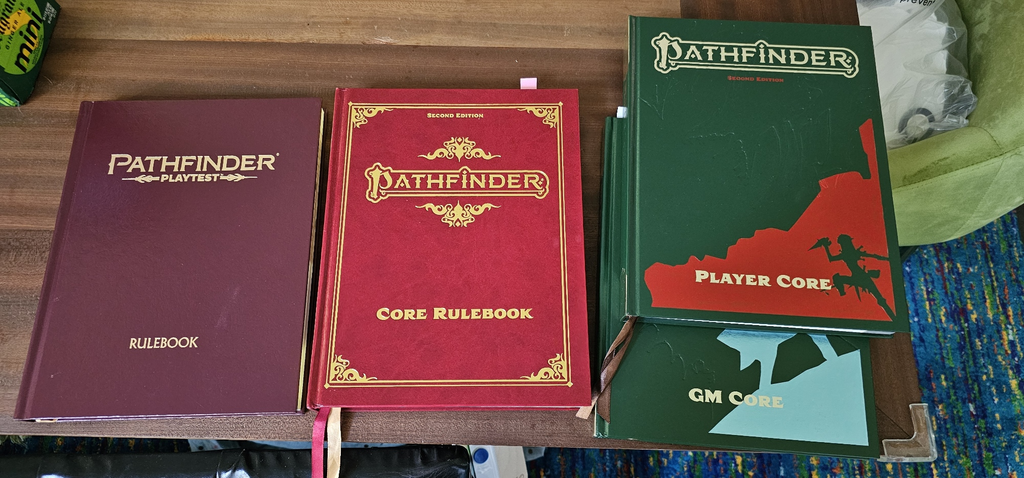
Let’s get this out of the way first.
The Pathfinder 2e Remaster is not a new edition of Pathfinder.
That isn’t just semantics. Paizo has been very explicit about it. In the original Remaster announcement, the company said the project did not change the fundamental design of Pathfinder Second Edition and that pre-Remaster monsters, spells, stat blocks, adventures, and other material should continue to work with the Remastered rules.
Now, does that mean nothing important changed?
Not at all.
There are enough changes that I completely understand why players sometimes refer to it informally as Pathfinder 2.5. Some classes play differently. Alignment is gone as a rules system. The traditional schools of magic disappeared. Familiar spells were rewritten or replaced. There are new monster mechanics and an entire layer of renamed terminology.
That is considerably more than changing the font and putting new covers on the books.
At the same time, if you’ve ever gone through an actual edition change in an RPG, you know what that usually looks like. Characters have to be rebuilt. Adventures need conversion. Monster numbers stop lining up. Supplements become tied to the old version. You are effectively choosing which version of the game your table is playing.
That is not what happened here.
In fact, Pathfinder Society’s own transition rules were specifically designed around keeping as much older material usable as possible and avoiding forced character rebuilds.
That tells us a lot about what the Remaster actually is.
So Why Did Paizo Do This in the First Place?
You can’t really talk about the Remaster without talking about the Open Game License controversy in 2023.
Pathfinder has always had an unusual relationship with Dungeons & Dragons. The original Pathfinder grew out of D&D 3.5 and was originally published using Wizards of the Coast’s Open Game License, better known as the OGL.
Pathfinder Second Edition had moved much farther away mechanically from D&D, but Paizo still published it under the OGL.
Then came the OGL controversy.
Without getting lost in all of the legal arguments that were flying around at the time, Wizards of the Coast’s proposed changes to the OGL created a tremendous amount of uncertainty throughout the tabletop industry. Paizo’s reaction was essentially that it did not want Pathfinder’s future dependent on a license controlled by another company.
That led Paizo and its partners to develop the Open RPG Creative License, or ORC.
And once Pathfinder was moving away from the OGL, Paizo had a problem.
Pathfinder still contained a number of terms, monsters, spells, magic concepts, and other elements that had come through that historical connection to D&D and the OGL.
So Paizo needed to separate Pathfinder from that material.
The Remaster became the opportunity to do it.
I think it is important to make a distinction here, though.
You will sometimes see the Remaster described as something Paizo was “forced” to do because of the OGL situation.
That goes too far.
The OGL controversy was clearly the catalyst, but Paizo also used the opportunity to clean up four years of Pathfinder 2e rules, incorporate errata, reorganize information, improve classes that were not working as well as intended, and make the core books easier for new players to use.
So what we ended up with is part licensing change, part errata collection, part rules cleanup, part class redesign, and part republishing project.
That explains why some changes feel significant while others really are just a different name for something you’ve already been doing.
What Actually Changed?
This is probably where things get confusing for someone looking at the Remaster for the first time.
There are a lot of changes.
But I don’t think they should all be treated equally.
For example, flat-footed became off-guard.
Spell level became spell rank.
Metamagic became spellshape.
Positive and negative terminology largely gave way to vitality and void.
Those are changes you have to learn, but they don’t fundamentally change how Pathfinder plays.
If your Rogue makes an enemy off-guard instead of flat-footed, the name changed. Your Rogue did not suddenly become a different class.
On the other hand, removing alignment from the game?
That has consequences.
Rebuilding the Oracle?
Definitely consequences.
Changing how Focus Points recover?
That can change what you do between encounters.
So rather than dumping 100 terminology changes into a list and pretending they all matter equally, I think it makes more sense to look at the places where the Remaster actually changes what happens at the table.
Goodbye Alignment…Sort Of
Pathfinder’s traditional nine-alignment grid is gone as a mechanical system.
No more Lawful Good, Chaotic Neutral, Neutral Evil, and so on controlling game mechanics in the same way.
That does not mean morality disappeared from Pathfinder.
Edicts and anathema now do much more of the work of explaining what a deity, philosophy, or character expects. Divine characters also interact with holy and unholy sanctification, while spirit damage handles some effects that previously depended on alignment-based damage.
I actually think this is a good example of a Remaster change that can sound bigger or smaller than it really is depending on the character you’re playing.
If you’re playing a Fighter who never cared much about alignment mechanically, you might barely notice.
If you’re playing a Champion whose entire class was built around alignment?
You are going to notice.
And that brings us to one of the biggest parts of the Remaster.
Some Classes Changed a Lot More Than Others
If you hear one person say, “My character barely changed,” and someone else say, “The Remaster completely changed my class,” they can both be telling the truth.
The class you play matters.
Witch
The Witch is one of the clearest examples of a class that benefited from the Remaster.
The original concept was great: a spellcaster whose magical power comes through a mysterious patron and is tied to a familiar.
The problem was that the mechanics did not always make that relationship feel as important as the concept suggested.
The Remaster puts much more emphasis on the familiar and patron mechanically, improves hexes, and gives the different patrons more distinct abilities.
This is not just changing names around.
If you’re playing a legacy Witch, I think the Remastered Witch is absolutely worth looking at.
Alchemist
The Alchemist received another substantial overhaul.
One of the longstanding challenges with the class was that playing an Alchemist well could involve predicting what the party was going to need before the adventuring day even started.
Prepare exactly the right tools and you could look brilliant.
Prepare the wrong things and…well, I hope everyone enjoys the twelve solutions you brought for problems the party never actually encountered.
The Remastered Alchemist introduces renewable versatile vials and changes Quick Alchemy and the research fields, giving the class considerably more flexibility during the adventuring day.
That tells you something else worth remembering: even the Remaster has received errata.
The books did not suddenly freeze Pathfinder’s rules forever.
Oracle
The Oracle may be one of the most interesting—and controversial—Remaster changes.
The original Oracle had a fantastic idea behind it: tremendous divine power that comes with a curse. The more you tap into that mysterious power, the more you deal with the consequences.
The problem was that the class could also be intimidatingly complicated. Paizo itself acknowledged that players often saw the original Oracle as requiring too many hoops just to access its potential.
The Remastered Oracle makes that system much easier to manage and separates cursebound abilities from the old curse progression.
Mechanically, I can see the argument that this is a cleaner class.
But this is also one of those places where “cleaner” does not automatically mean “better for everybody.”
Some Oracle players liked the strange give-and-take of the original mystery and curse system. For them, simplifying the mechanics also took away some of what made the class interesting.
That actually reminds me a little of the old AD&D 2nd Edition Paladin. Part of what made the Paladin feel special was that it was powerful, but there were also some very strict limitations attached to playing one. Remove too many of the restrictions and, yes, you may make the class easier to play—but you may also remove some of what gave it its identity in the first place.
I think the Oracle raises a similar question.
Sometimes complexity is bad design.
Sometimes complexity is part of the flavor.
Figuring out which is which is where reasonable people can disagree.
Champion
The Champion almost had to change.
The class was so heavily tied to alignment that removing alignment from Pathfinder meant Paizo could not simply change a few terms and call it a day.
Player Core 2 therefore gives the Champion a much more extensive overhaul built around causes, tenets, deities, and the new sanctification system.
If you’re running an older Champion, this is another class where I would take the time to look seriously at the Remastered version.
Wizard
The Wizard presents a different problem.
The class is still very recognizably a Wizard. You’re still an Intelligence-based prepared arcane caster learning magic through study.
But the old eight schools of magic—Abjuration, Conjuration, Divination, Enchantment, Evocation, Illusion, Necromancy, and Transmutation—were removed as the underlying structure of magic.
That mattered quite a bit to Wizards because their subclasses were built around those schools.
The Remaster replaces them with actual magical curricula: schools such as Battle Magic built around collections of spells that represent what the Wizard studied.
Paizo’s reasoning makes sense. The old system left very little room to create new Wizard schools because all eight traditional categories were already spoken for. Curricula can be expanded indefinitely.
Do I think everyone is going to prefer the new system?
Probably not.
A curriculum can be more flavorful, but it can also feel more restrictive if the spell list for your chosen school does not line up particularly well with the Wizard you imagine playing.
That makes Wizard another good example of why I don’t think this article can simply end with “new version good, old version bad.”
It is more complicated than that.
Other Classes Got Better Without Becoming Different Classes
Then there are classes where the Remaster feels more like someone went through the design with a wrench and tightened up the loose parts.
The Cleric, for example, no longer needs Charisma to determine the size of its Divine Font. Warpriests also received improvements to their weapon progression. The class is still very clearly the Cleric you knew before, but some awkward mechanical pressure disappeared.
The Barbarian no longer carries the same blanket AC penalty from Rage and can enter Rage more easily at the beginning of combat.
The Swashbuckler received improvements intended to make gaining Panache more reliable rather than having the class’s central mechanic become harder to access exactly when an encounter gets difficult.
The Ranger received cleanup and improvements without Paizo trying to reinvent a class that was already working pretty well.
Bard, Fighter, Rogue, Druid, Monk, Sorcerer, and Investigator all received changes of one kind or another, but I would not put them in the same category as the Alchemist, Oracle, Champion, Witch, or Wizard.
This is why I would never tell an existing Pathfinder group, “Everybody needs to rebuild their characters because of the Remaster.”
That solves a problem most characters do not have.
Magic Changed More Than Just a Few Spell Names
Spellcasting is another area where the Remaster can look cosmetic until you start digging.
The obvious change is that spell levels are now spell ranks.
Honestly, I like that one simply because RPGs have spent decades asking the word “level” to do entirely too much work.
Character level.
Spell level.
Item level.
Dungeon level.
At some point the poor word deserves a break.
But there are more meaningful changes here.
Traditional spell components—verbal, somatic, material, and focus—were removed as their own layer of rules. Instead, traits such as concentrate and manipulate appear directly where they matter.
Paizo’s reasoning was that the component system was both tied to OGL material and unnecessarily indirect. If a somatic component really meant “this action has the manipulate trait,” why make the player remember the extra step?
That is the kind of cleanup I appreciate because it eliminates a rule you have to translate in your head.
Focus Points also became easier to recover.
For characters built around focus spells, that matters a lot more than whether we now say “rank” instead of “level.”
And then there are the spells themselves.
Some spells were renamed.
Some were replaced.
Some were rewritten enough that treating them as a simple rename would be misleading.
One of my favorite examples is produce flame and ignition.
Ignition fills a similar thematic space, but Pathfinder Society’s official guidance explicitly allowed the two to exist as separate spells. A character could even know both.
So if you are converting an old character, don’t assume every new spell with a familiar concept is just the old spell with the serial numbers filed off.
Sometimes it is.
Sometimes it isn’t.
Monsters Still Work—But There Are Some Real Changes
Monster Core is probably reassuring for Game Masters who already own multiple Bestiaries.
Paizo did not throw out Pathfinder’s monster math and start over.
That means an old creature does not suddenly become unusable because your players are using Player Core characters.
Monster Core does reorganize the creature lineup, replace some OGL-associated monsters, introduce new Pathfinder-specific creatures and dragons, update terminology, and integrate several years of errata.
There are also some small-looking changes that affect actual combat.
Grab is a good example.
Under the old rules, certain monster abilities following an attack could effectively happen automatically.
The Remaster changed abilities such as Grab so the monster attempts the appropriate check instead.
That means a player who invested in being difficult to grapple now gets to benefit from that investment.
That is a better change, in my opinion, than another renamed trait because the player actually feels it when the dice hit the table.
What Are All These New Core Books?
This is another place where I think Paizo unintentionally made the Remaster look more intimidating than it is.
There are four primary Remaster core books:
Player Core contains the main player rules and the Bard, Cleric, Druid, Fighter, Ranger, Rogue, Witch, and Wizard.
GM Core contains the rules and tools primarily aimed at running the game.
Monster Core is the main Remastered monster collection.
Player Core 2 contains the Alchemist, Barbarian, Champion, Investigator, Monk, Oracle, Sorcerer, and Swashbuckler along with additional ancestries, archetypes, equipment, spells, and other options.
The mistake would be thinking that every player now needs four books.
They don’t.
If you’re playing a Fighter, Player Core 2 is not required just because “Core” is printed on the cover.
If you’re playing an Oracle, on the other hand, Player Core 2 becomes a lot more interesting.
And if you’re a player rather than the GM, Monster Core probably isn’t high on your shopping list at all.
That brings us to the question I suspect most longtime Pathfinder players actually care about.
What Happens to All My Old Pathfinder Books?
You keep using them.
Really.
This may be the most important thing to understand about the entire Remaster.
Paizo did not declare your old Pathfinder 2e library obsolete.
Paizo also released compatibility errata specifically for older books including the Core Rulebook, Advanced Player’s Guide, Secrets of Magic, and Dark Archive. That compatibility work has continued years after the Remaster launched.
That is pretty strong evidence that “legacy” does not mean “dead.”
And I admit I had to smile when I was writing this section because I am exactly the person this question is aimed at.
I own the old books.
I also own the new Remaster books because I’m on the Paizo subscription.
So when somebody looks at a shelf containing a Core Rulebook, Gamemastery Guide, Bestiaries, supplements, and Adventure Paths and says, “Wait a minute. I already bought all this stuff,” I get it.
Amen.
And as you can see from the picture of my bookshelf, I really do have both sides of this argument sitting right there on the shelf.
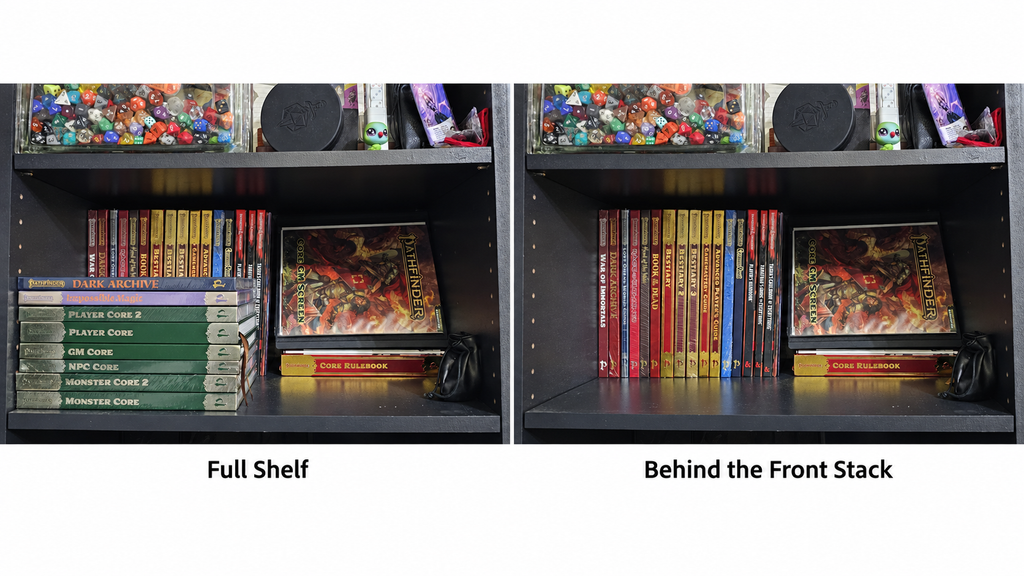
The good news is that buying the Remaster books did not make the older books disappear from my game.
Suppose you’re running an Adventure Path you bought five years ago.
The adventure says a creature is flat-footed.
Today we say off-guard.
Okay.
The adventure references an older spell.
Use the legacy spell or the appropriate current version.
A monster has an ability that has since been updated as a general rule.
Use the current rule.
You do not need to sit down before your next session and rewrite 300 pages of an Adventure Path.
I certainly wouldn’t.
I would update things as they actually come up.
Should You Rebuild an Existing Character?
Again, I think the class matters.
If you’re happily playing a Fighter and your campaign is running fine, I see very little reason to tear the character apart just because the Remaster exists.
Start using the current universal rules and terminology where it makes sense and keep playing.
If you’re a Witch?
I’d look at the new version.
Alchemist?
Definitely worth looking.
Oracle or Champion?
I would at least compare the versions carefully.
Wizard?
You need to decide how you want to handle the shift away from the traditional school structure.
That is a much more reasonable approach than telling an entire table they need to convert simultaneously.
Pathfinder Society took a similar approach during the transition. It adopted the updated general rules while explicitly allowing older character options that had not been reprinted to continue being used.
Your home campaign can be even more flexible.
Do Existing Players Need to Buy the New Books?
No.
That is the easiest answer in this entire article.
You do not need to replace your Pathfinder collection just to keep playing Pathfinder Second Edition.
Archives of Nethys gives players access to current rules, and Paizo continues publishing official errata and compatibility updates.
That does not mean I think the books have no value.
If Pathfinder is one of your main games and you like physical rulebooks, there is something to be said for having the current rules organized in one place rather than mentally translating terminology and checking errata every time something looks suspicious.
The value proposition also changes depending on your class.
A Witch player is getting considerably more out of Player Core than someone whose existing character barely changed.
A Champion, Oracle, or Alchemist player may find Player Core 2 much easier to justify.
A GM who expects to run Pathfinder for years might appreciate GM Core and Monster Core simply because newer material increasingly speaks the Remaster’s language.
But that is convenience.
It is not a mandatory upgrade fee.
I think that’s an important distinction.
What Should a New Player Buy?
For someone starting Pathfinder today, my advice is much simpler:
Start with the Remaster.
There is almost no reason for a brand-new player in 2026 to deliberately learn the old terminology first and then translate it into the version Paizo currently supports.
Paizo itself now recommends Player Core as the starting point for experienced tabletop gamers and GM Core for Game Masters.
If Pathfinder—or tabletop RPGs in general—is completely new to you, there is also a new Pathfinder Beginner Box: Secrets of the Unlit Star, released in May 2026, designed specifically as the current on-ramp to the game.
So my buying path would look something like this:
If you’re completely new to tabletop RPGs, start with the Beginner Box.
If you already understand tabletop RPGs and want to play Pathfinder, start with Player Core.
If the class you want is in Player Core 2, add that.
If you’re going to GM, add GM Core.
Then buy Monster Core and the rest of the line because you actually want what’s in them—not because you think Paizo has declared all four mandatory.
Your wallet will appreciate the distinction.
Where I Think the Remaster Clearly Makes Pathfinder Better
After going through all of this, there are changes I have a hard time seeing as anything other than improvements.
The Focus Point recovery rules are cleaner.
Clerics no longer having to lean on Charisma just to increase Divine Font removes an awkward bit of character building.
The Witch’s patron and familiar now better support the class fantasy.
The Alchemist has more flexibility instead of requiring quite as much crystal-ball planning at the beginning of the day.
Swashbucklers have more reliable access to the mechanic their class revolves around.
Monster abilities such as Grab now interact better with player defenses.
Spell traits being printed directly on the spell rather than indirectly inherited from spell components eliminates unnecessary rules translation.
And I think consolidating years of errata into a cleaner starting point is simply good for new players.
Those are meaningful improvements.
Where I’m Less Convinced
There are other areas where I don’t think there is one objectively correct answer.
Wizard schools are probably the easiest example.
I understand why Paizo replaced the old magic schools. I also understand the design advantages of creating curricula that can expand indefinitely.
But I can also understand someone saying, “I liked being an Evoker. Why is my Wizard’s identity now tied to this particular curriculum?”
The Oracle is another.
The Remastered Oracle is easier to understand and easier to operate.
But if what you loved was the strange mechanical dance between the benefits and consequences of your mystery’s curse, you may feel like something got lost.
And then there is the simplest complaint of all:
“I already bought these books.”
That’s fair.
If you own a Core Rulebook, Gamemastery Guide, Advanced Player’s Guide, three Bestiaries, Secrets of Magic, Dark Archive, and a pile of Adventure Paths, seeing a new group of “core” books appear a few years later can understandably make you wonder how much of that library you’re expected to buy again.
In my case that question is not theoretical. I really do own the older books and the new ones.
The good news is that the answer is: not nearly as much as it first appears.
The Biggest Problem May Be Having Two Pathfinder Languages
I actually think this may be the biggest everyday annoyance created by the Remaster.
Legacy material says flat-footed.
New material says off-guard.
An old book refers to positive damage.
A new one talks about vitality.
Your old Wizard uses schools of magic that the new Wizard doesn’t.
A spell in an Adventure Path has an old name while your rules reference shows something different.
None of those things necessarily breaks the game.
But they can slow it down.
You end up asking:
“Wait, is that the old version?”
“Did this spell actually change or did they just rename it?”
“Does this feat still work?”
“Which Grab rule are we using?”
I’ve actually run into this kind of thing before, although it wasn’t even a Remaster issue at the time.
A couple of years ago, during one of my Pathfinder games, we got into an argument about whether a fireball could go through a window. The guys kept talking about the fireball’s “bead,” and I could not figure out what bead they were talking about.
We went back and forth for a while before we finally realized what was happening.
They were using Dungeons & Dragons terminology while I was looking at the Pathfinder 2e rules.
Nobody at the table had suddenly forgotten what a fireball was. We were just speaking two slightly different RPG languages.
That experience is probably why this particular part of the Remaster stands out to me.
When one person says flat-footed and another says off-guard, everybody may ultimately understand what is meant, but you still have that moment where the game stops while everybody makes sure they are talking about the same rule.
That is what I would call reference friction.
And ironically, I think reducing that friction may be one of the strongest reasons for an established group to gradually adopt the Remaster.
Not because your old books stopped working.
Because eventually everyone speaking the same version of Pathfinder makes things easier.
So…Is the Pathfinder 2e Remaster Worth the Switch?
After all of that, I still don’t think there is one answer.
If you’re starting Pathfinder today?
Absolutely start with the Remaster.
That is the Pathfinder Paizo is building forward from, and learning the legacy version first accomplishes very little.
If you’re already playing Pathfinder 2e?
I would adopt the current general rules, look carefully at any class that received a major overhaul, and otherwise keep playing.
If you’re a GM with a shelf full of old adventures?
Please don’t start replacing them.
Use them.
If you own the original rulebooks and are perfectly comfortable using Archives of Nethys and checking errata?
You don’t need to run out and buy everything again.
And if Pathfinder is one of your main games, you enjoy having physical references at the table, and you expect to follow the game for years?
Then I think moving your core reference library to the Remastered books makes increasingly good sense.
Maybe that sounds like I’m dodging the title of the article.
I don’t think I am.
For me, the biggest mistake would be treating “switching to the Remaster” as one giant decision.
It isn’t.
You can switch to the current rules without replacing your adventures.
You can switch your Witch without rebuilding your Fighter.
You can buy Player Core without buying four books at once.
You can keep using legacy character options that were never replaced.
You can move your campaign toward the Remaster gradually rather than declaring that everything published before November 2023 is now forbidden.
And maybe that is the real strength of what Paizo did.
The Remaster gives Pathfinder Second Edition a cleaner foundation to build on without requiring players to burn the foundation they already had.
It isn’t Pathfinder 3e.
It isn’t nothing, either.
It is Pathfinder 2e after several years of use, several years of lessons, a major licensing fight, and a chance to go back and ask, “If we were publishing these rules today, what would we do differently?”
Some of those answers are clearly better.
Some are mostly different.
And a few are probably going to be argued about around Pathfinder tables for years.
Which, honestly, is pretty normal for tabletop gamers.
So I’m curious: if you’ve already moved your group to the Remaster, which changes actually made your game better—and which legacy rules or character options are you still hanging onto?
Leave a Reply
You must be logged in to post a comment.