
Listen to this Article
The best starter RPGs for new players are not always the easiest games to learn.
What makes a good first tabletop role-playing game?
The obvious answer seems like it should be the easiest game to learn. Find something with a small rulebook, simple character creation, a few dice rolls to remember, and you are done. Right?
I am not so sure.
My first RPG was not Dungeons & Dragons. In fact, when my friends first tried to get me to play D&D, I wanted nothing to do with it. I had bought into some of that old nonsense about Dungeons & Dragons being tied to devil worship, and I simply was not interested.
Then I was over another friend’s house and saw Marvel Super Heroes.
Now that got my attention.
I was already an avid Marvel fan. I knew the characters. I knew the world. I understood superheroes. Suddenly this strange thing called a role-playing game was not asking me to care about something completely unfamiliar. It was offering me a chance to step into something I already loved.
I played Marvel Super Heroes, and I loved it.
After that, the friends who had been trying to get me into D&D basically said, “Okay, now you have to play the granddaddy game.”
So I did.
And my first D&D experience was terrible.
There were probably seven or eight players at the table, most of them veterans, and here I was brand new to the game. I had chosen a paladin, which was not exactly the easiest first character to learn, and I had spent a lot of time trying to make sure I built and played him correctly according to the rules.
At some point we were exploring a dungeon, and another player’s character was shooting a crossbow. The DM warned that there was a chance he could hit one of us instead. He nearly did, and I complained about it.
His response was to fire both crossbows at me.
My first-level paladin went down.
I remember the DM then telling me that I could have used my shield to block. The problem was that I was the new guy. I did not know that. Everyone else at the table understood things about the game that I was still trying to learn.
At the time, I remember thinking the whole thing was kind of silly. I had spent all that time creating this character and trying to understand the rules, and then this was the experience I got once we actually started playing.
I did not have fun.
Thankfully, that was not the end of the story.
The next time we played, another DM took over. He was very experienced, and my experience with D&D changed completely.
I fell in love with the game.
Over the years I would go on to play Pathfinder, Robotech, Mutants & Masterminds, Vampire: The Masquerade, Top Secret, d20 Modern, and plenty of other games.
Looking back at that path made me wonder whether we sometimes ask the wrong question when introducing somebody to tabletop RPGs.
Maybe the question should not be, “What is the easiest RPG for a beginner?”
Maybe it should be, “What RPG gives this particular beginner the best reason to want to play—and what are we doing to make sure they have a good first experience?”
Beginner-Friendly Does Not Mean Just One Thing
When people talk about beginner-friendly RPGs, rules complexity usually dominates the discussion. That makes sense. Nobody wants someone’s first gaming experience to be three hours of flipping through rulebooks trying to figure out whether they can open a door.
But complexity is only one part of the problem.
There is the amount the player needs to learn, but there is also the amount the Game Master needs to learn. There is character creation, preparation time, how well the game teaches itself, whether there are pregenerated characters, whether the introductory adventure actually explains what the GM is supposed to do, and how much material somebody needs to buy before they can even begin.
Then there is something harder to measure: does the person actually care about what the game is offering?
A game can have beautifully simple mechanics and still leave somebody cold.
Another game might ask that same person to learn more rules but have them sitting forward at the table because they cannot wait to find out what happens next.
That matters.
And there is something else that matters which no rulebook can completely solve:
How does the table treat the new player?
Easy for the Player Is Not Always Easy for the GM
One of the more interesting things I found while researching this article was how often “easy to play” gets confused with “easy to run.”
They are not the same thing.
Some rules-light and narrative games give players wonderfully simple tools. Tell us what your character does, make a roll when the rules call for it, and keep the story moving.
That sounds ideal for beginners.
But who decides what happens when the rules deliberately leave something open?
Usually the GM.
Suddenly that very simple game may be asking a first-time GM to improvise consequences, judge what is reasonable, maintain the pace of the story, portray NPCs, understand the genre, and make fair rulings without a lot of mechanical structure supporting those decisions.
For an experienced GM, that freedom can be wonderful. I have been doing this long enough that “make a reasonable ruling and keep going” does not frighten me.
Think about somebody running their first RPG ever, though.
Sometimes “there isn’t a rule for that” is freedom.
Sometimes it is terrifying.
This is where a game like Pathfinder 2e becomes interesting. Nobody is going to mistake Pathfinder for a rules-light RPG. There are a lot of character options and plenty of mechanics to learn. But detailed rules also mean that many questions have actual answers. A new GM does not always have to invent one.
That does not magically make Pathfinder easy, but it demonstrates why page count alone is a poor way of deciding whether something is suitable for beginners.
It also explains why I think one of the first questions we should ask is not just “Who are the new players?”
It should be “Who is running the game?”
Four new players being introduced by a veteran GM is a very different situation from five friends sitting around a table where nobody has ever played an RPG before.
The Starter Experience May Matter More Than the Full Game
There is another mistake we can make when comparing RPGs. We look at the complete game instead of looking at what a new player will actually encounter first.
Modern starter products have gotten pretty sophisticated.
Dungeons & Dragons now has Heroes of the Borderlands, which uses maps, cards, tokens, pregenerated material, and guided play to introduce the game rather than simply dropping the Player’s Handbook in front of somebody and wishing them luck.
Pathfinder’s current Secrets of the Unlit Star Beginner Box takes the same basic idea seriously. It includes separate material for players and GMs, pregenerated characters, a solo learning adventure, reference cards, maps, pawns, and an introductory group adventure.
That matters.
The full Pathfinder rules may be complicated, but a beginner does not have to absorb the full Pathfinder rules on Tuesday night before playing on Wednesday.
Call of Cthulhu provides another good example. Its Starter Set begins with Alone Against the Flames, a solo adventure that teaches someone by actually having them play. Instead of reading fifty pages explaining what role-playing feels like, you start making decisions.
I really like that approach.
Fabula Ultima does something similar with Press Start, a free tutorial adventure using pregenerated characters. The full game gives players plenty of character-building options, but the introductory experience temporarily gets that complexity out of the way and teaches the parts you need right now.
That is what good onboarding does.
It does not necessarily remove complexity from a game. It controls when you encounter it.
Maybe Start With What They Already Love
This brings me back to Marvel Super Heroes.
Did being a Marvel fan make the game’s dice mechanics easier for me?
No.
But it removed another kind of learning entirely.
I did not need somebody to explain why superheroes were interesting. I already knew that.
I understood what heroes did, what villains did, what superpowers looked like, and what kind of adventures belonged in that world. There was already something there that I wanted.
That is worth considering whenever we introduce someone to RPGs.
Suppose someone has spent years playing Final Fantasy and other Japanese RPGs. Fabula Ultima might make more immediate sense to them than generic medieval fantasy. They already recognize the language of dramatic heroes, party roles, elemental powers, extravagant villains, and journeys that eventually involve saving the world.
Someone who loves horror may understand the appeal of Call of Cthulhu before they know what a percentile roll is.
Someone who loves Avatar may have a much easier time imagining a character in Avatar Legends because they already understand that universe.
And somebody who grew up reading Marvel comics may look at the current Marvel Multiverse Role-Playing Game and experience exactly the same reaction I had all those years ago:
“Wait. I can play this?”
Now, I want to be careful here. I did not find research proving that licensed RPGs automatically make people better tabletop gamers or that someone learns mechanics faster because Spider-Man is on the cover.
That would be stretching the evidence.
What makes more sense is that familiarity can reduce what I would call the fictional learning curve. You may still have to learn the game’s rules, but you do not also have to learn what this world is, what kinds of characters belong in it, and why you should care.
More importantly, enthusiasm can make someone willing to learn.
I have watched people memorize ridiculously complicated systems in video games because they desperately wanted to master that game. Tabletop players are not fundamentally different.
Sometimes the person does not need the simplest RPG.
They need an RPG they cannot wait to play.
How to Choose the Best Starter RPGs for New Players
This is where I have trouble giving somebody a traditional Top Ten list.
I do not think there is one answer.
If somebody comes to me and says, “I want to play D&D,” I am probably going to introduce them to D&D.
There are mechanically simpler fantasy games. That is not the point. They already told me what excites them. D&D also has an enormous ecosystem around it, from groups and adventures to digital tools and instructional material, and Heroes of the Borderlands gives newcomers a much more controlled way into the current game than simply buying core rulebooks.
If someone wants fantasy but does not specifically care about D&D, Dragonbane becomes very interesting. It keeps a lot of the familiar fantasy language while reducing the rules load and preparation burden. For a completely new group with a completely new GM, that combination has a lot going for it.
If I have someone who enjoys character optimization, tactical combat, and digging into build choices, I would not automatically steer them away from Pathfinder 2e because it is complicated. That complexity may be part of what they enjoy. I would just make sure they come in through the Beginner Box rather than dumping the entire game on them at once.
For the horror fan, Call of Cthulhu is an easy game for me to point toward. The basic mechanics are approachable, its Starter Set does a particularly good job of teaching through play, and the premise is immediately understandable to someone who already enjoys horror and mysteries.
If somebody says, “I don’t want to read a pile of rules. I just want to see what this role-playing thing is,” games such as Quest deserve attention. Quest’s digital rules and introductory material make trying the game extremely low risk, and the basic mechanics stay out of the way.
Shadowdark, along with games such as Cairn and Mausritter, also gets characters moving quickly and keeps the mechanical overhead low. There is a catch, though, and it is an important one: simple rules do not necessarily mean forgiving gameplay.
Old-school-inspired games often expect players to be cautious, investigate their environment, avoid unnecessary fights, and accept that bad decisions can have serious consequences.
That leads to another distinction I think beginner guides frequently miss.
A game can be forgiving when you forget a rule and absolutely unforgiving when your character kicks open the wrong door.
Those are not the same thing.
For the person who loves Japanese RPGs, Fabula Ultima may be one of the most interesting examples of matching the game to the player. Its full character system has real depth, but Press Start gives newcomers a controlled tutorial experience while immediately delivering the kind of adventure they came for.
Then there are people like younger me.
If someone looks at all of those games with mild interest and then suddenly lights up when they see Marvel, Avatar, Transformers, Star Wars, or another world they already love, I would pay attention to that reaction.
That excitement is information.
What About Rules-Light Games?
I don’t want to give the impression that rules simplicity does not matter. It absolutely does.
I just think we oversell it sometimes.
Rules-light systems can be fantastic introductions because players spend less time looking at character sheets and more time describing what they want to do.
But there can also be a hidden cost.
Sometimes removing rules does not remove work.
It moves the work.
Instead of the rulebook answering a question, the GM answers it.
Instead of a detailed subsystem determining what happens, the table negotiates what makes sense.
Again, experienced groups may love that. Some new groups will love it too.
Other new GMs may desperately wish the book would just tell them what number to use.
That is why I would never tell someone, “This game only has twenty pages of rules, therefore it is automatically a better first RPG than that 300-page game.”
What do those twenty pages expect the GM to do?
That is the more interesting question.
Sometimes the Table Is the Beginner Problem
Years after my own bad first D&D experience, I saw the same issue from the other side.
My wife wanted to try playing.
By then I was the experienced DM, and I was busy preparing the game itself. I asked one of the other players to help her create her character and explain things to her while I finished getting everything ready.
The problem was that the player I had asked did not have much patience.
He was younger, he understood the game, and I am sure everything he was explaining probably seemed obvious to him.
It was not obvious to her.
His impatience upset her, and it changed what should have been an exciting introduction to the game into a frustrating experience.
Afterward, several of the experienced players got on him about it. Around our table there was basically an unwritten rule: you show patience with a new player.
They do not know what you know yet.
That sounds obvious, but I think longtime gamers forget it more often than we would like to admit.
We abbreviate terminology. We assume people know which die to roll. We point at something on the character sheet as though its purpose is self-explanatory. Someone asks the same question a second or third time and we wonder why they have not remembered it yet.
Meanwhile they are trying to understand a character sheet, the rules, the fictional world, what everybody else is doing, when they are supposed to speak, and whether they are somehow holding up the game.
That is a lot.
Looking back, I also realize that I bear some responsibility for my wife’s experience. I was the DM. I knew she was new. I delegated that job because I was trying to prepare everything else.
I chose someone who knew the rules.
What I should have made sure of was that I chose someone who knew how to teach them.
Those are not necessarily the same thing.
That lesson applies just as much to my first D&D game.
I was sitting at a table full of people who knew far more about D&D than I did. When I failed to know something, I was essentially told what I should have done after the fact.
Then another DM took over the next session, and suddenly I loved the game.
Same player.
Same RPG.
Completely different experience.
The Table Matters Too
That is another reason I hesitate when people argue too strongly about which system creates the perfect first RPG experience.
The rules matter.
The adventure matters.
The GM matters.
The other players matter.
And patience matters.
A great starter box cannot fix a table that makes the new player feel stupid for not knowing things they have never been taught.
A beautifully simple RPG cannot overcome somebody getting irritated every time the newcomer asks a question.
On the other hand, a good GM and a patient group can make a fairly complicated RPG feel surprisingly approachable because the newcomer never has to learn everything at once.
Maybe that is one of the most important things experienced gamers can remember when introducing someone new:
Your job is not to prove how much you know about the game. Your job is to help them discover why you love playing it.
The Best Starter RPG Is the One That Gets Them to the Second Session
After digging into all of this, I no longer think I would recommend a beginner RPG by starting with mechanical complexity.
I would start with the person.
What kind of stories do they already love?
What worlds get their attention?
Do they want tactical battles or mostly conversation and storytelling? Do they enjoy building complicated characters, or does a page full of options make their eyes glaze over? Are they joining an experienced GM, or is everybody learning together? Do they want an ongoing campaign, or are they simply curious enough to give RPGs one evening?
And just as importantly:
Who is going to help them learn?
Once I know those things, then I start looking at rules.
That approach probably would have worked on younger me.
You could have put the simplest fantasy RPG ever written in front of me and I still might not have cared.
Put Marvel superheroes in front of me?
Now you had my attention.
But getting someone to sit down at the table is only half the job.
When they get there, we need to remember that every rule we take for granted was once something we did not know either.
Maybe that is the real job of a good starter RPG—and a good gaming group.
Not to make someone’s first session perfect.
Just to make it good enough that when the dice are put away, they ask:
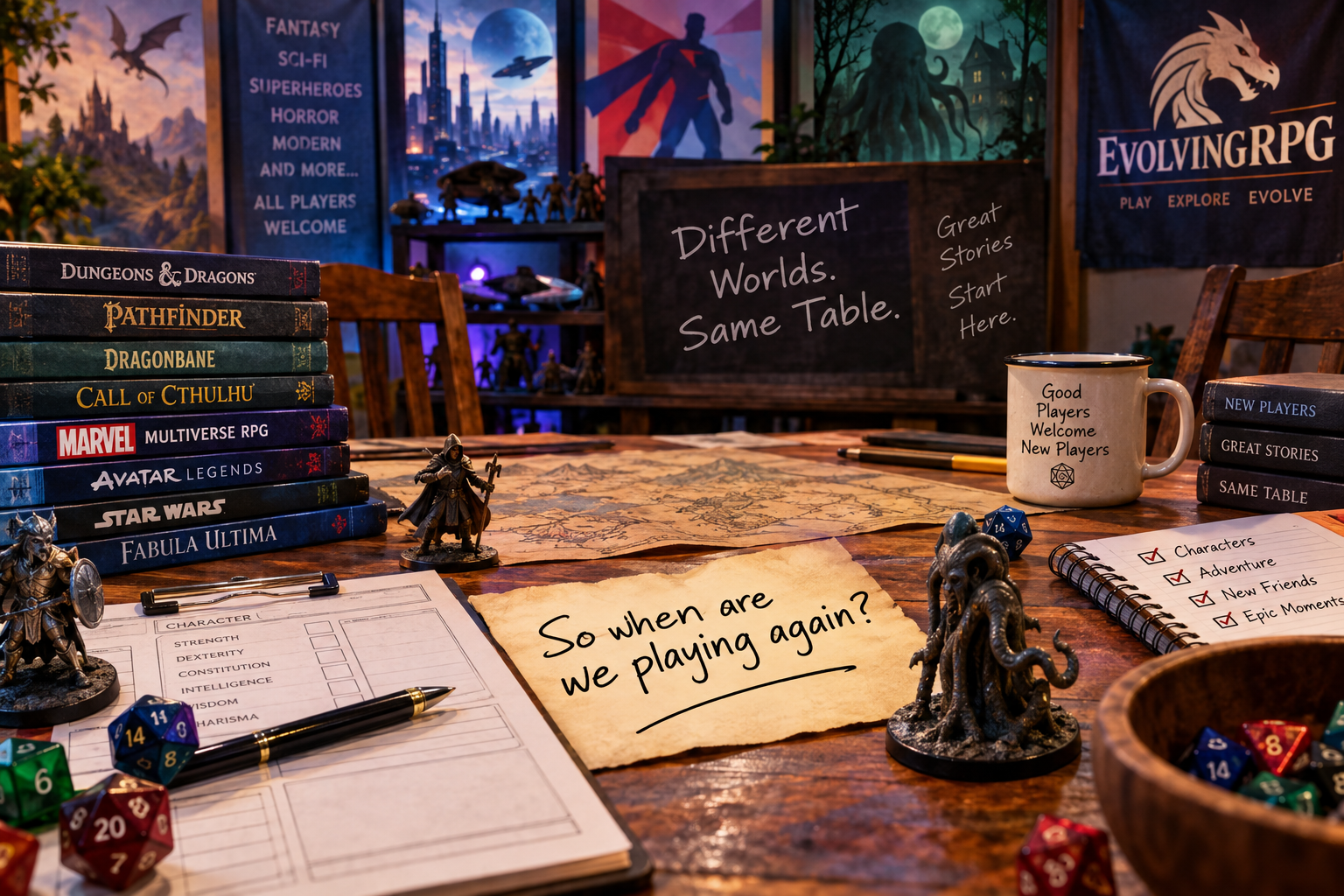
“So when are we playing again?”
Leave a Reply
You must be logged in to post a comment.