
Several years ago, when Paizo released the playtest for what would eventually become Pathfinder Second Edition, I knew I wanted to learn the new system.
I liked Pathfinder. I also found the original game to be overly complicated in places, and at the same time, Dungeons & Dragons 5E was becoming the game everybody seemed to be playing.
And me being me, I was a little contrary.
All of my friends were getting into 5E, so I knew I was going to have plenty of opportunities to play it. But if I was going to run something myself, I wanted to do something different.
I decided that would be Pathfinder.
What I probably didn’t realize at the time was just how big of a commitment I was about to ask everyone to make.
I wasn’t thinking much about Pathfinder campaign management at the time. I was thinking about the game I wanted to run and the kind of long-term campaign I’d never really had the opportunity to experience.
Can You Give Me Ten Years?
While we were going through the Pathfinder playtest, I asked my friends a somewhat ridiculous question:
Could they give me a ten-year commitment?
I wanted to run one campaign from beginning to end, taking the characters from 1st level all the way to 20th level.
There were a couple of reasons for that.
First, I wanted a stable group that would give me an opportunity to do things as a GM that I’d never really had the chance to do before. One of those things was running genuinely high-level adventures.
For many of my players, that would also be something new. Most of them had never played particularly high-level characters, and I don’t think any of my friends had ever taken the same character all the way from 1st level to maximum level.
So that became part of the experiment.
We weren’t just going to play until the campaign fizzled out. The plan was to watch these characters grow from beginning adventurers into whatever they eventually became at 20th level.
After the playtest ended and Pathfinder Second Edition was officially released, we transitioned the campaign to the finished rules. According to my notes, our first session using the final Second Edition rules was November 9, 2019.
We try to play about every other month—roughly six times a year—although real life doesn’t always cooperate. Sessions usually run somewhere between four and six hours, with about five hours being the target.
The group is made up of seven players, and at this point I consider us roughly halfway through the ten-year campaign I originally asked everyone to commit to. There’s still another five years or so of adventuring ahead of us, assuming everything goes according to plan.
That may not sound like an enormous amount of gaming when you’re only playing a handful of times each year, but when you combine seven characters, years of history, NPCs, locations, factions, side quests, promises, character goals and everything else that develops naturally during a long-running campaign, you end up with a surprising amount of information to keep track of.
For a long time, I did what I’ve always done.
I used paper.
When the Notebook Started Feeling Too Small
I would write encounters in a notebook or create them on the computer and print them out. During the session, I’d take notes. Later, I’d go back through those notes trying to remember what happened, what the players had done and what I wanted to follow up on.
That worked.
Until I started getting the feeling that eventually something was going to slip through the cracks.
I don’t actually think I had lost anything important yet. It was more the feeling that I could.
There were too many side stories developing. Too many NPC relationships. Too many little promises and character moments that might become important six months or even two years later.
And because of the way I designed this campaign, those things matter.
Before we started, I asked my players what they wanted out of the game. What did they want their characters to accomplish? How did they see their characters interacting with the world? What kind of history did they have?
Some players embraced that completely and gave me plenty to work with.
Others were basically, “Just keep the game going. I’m happy to play.”
And that’s perfectly fine.
But for the players who gave me those hooks, I wanted to make sure I remembered them.
I needed something better than flipping through a notebook hoping I remembered where I wrote something three years ago.
That’s when I started experimenting with MediaWiki.
Using MediaWiki for Pathfinder Campaign Management
I like to tinker with technology, so I already had my own little web server running at home.
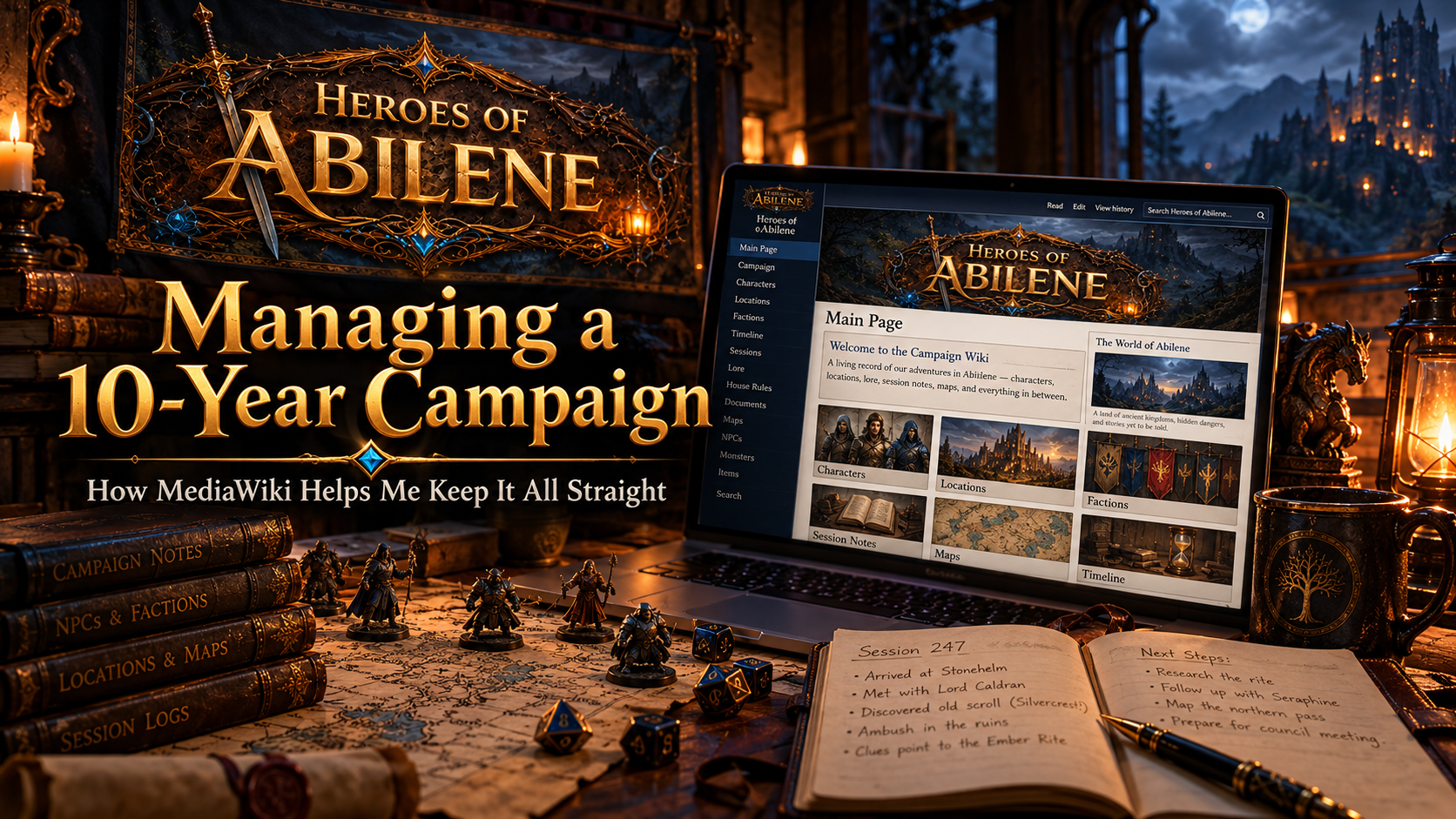
I installed MediaWiki and created a private wiki for the campaign, which is called Heroes of Abilene.
At first, the idea was pretty simple.
I was going to enter each player character.
Then I started entering their goals.
Then their history.
Then journals the players had written.
Then notable things they had encountered.
You can probably see where this is going.
Once I realized how useful it was to have all of that information interconnected and searchable, I didn’t stop with the characters.
I started adding session notes.
Then encounters.
Then monsters.
Then locations.
Maps.
Factions.
NPCs.
Relationships between those NPCs and the player characters.
And eventually I created my own GM section for information that I specifically need to keep track of behind the scenes.
That’s where I can track active side quests, promises I’ve made to players, things the characters have said they want to accomplish and NPC relationships that may become important later.
For an NPC, for example, it isn’t enough for me to remember that the players met them.
What does that NPC think about the characters now?
Did the party help them?
Embarrass them?
Save their life?
Lie to them?
Does the NPC trust the group? Dislike one particular character? Owe somebody a favor?
That is the type of information that can make a character reappearing two years later feel meaningful instead of feeling like I pulled an old NPC name out of a hat.
Making Sure Every Player Gets Their Moment
This may actually be the most important benefit I’ve gotten out of the wiki.
With seven players, it would be very easy for somebody to get overlooked.
The MediaWiki makes it much easier for me to periodically go through each character and ask myself:
What is happening with this character?
What haven’t I touched recently?
Was there something in this character’s background that I haven’t explored?
Did I promise this player an opportunity to do something?
Is there an NPC relationship I could bring back into the story?
At the end of the day, each player is one of the stars of the story.
Everybody should eventually get their moment in the spotlight.
If there is something from a character’s past that the player wants to confront, accomplish or resolve, I want to give that player an opportunity to do it.
That doesn’t mean I have to hand them the outcome they want.
But the opportunity should be there.
And when you’re talking about a campaign measured in years instead of months, having all of this information available at my fingertips makes weaving those things naturally into the larger story much easier.
What I Track for Each Character
My character pages have evolved quite a bit since I first created them.
I usually start with an image of the character, their name and a basic character overview.
Some of the older information needs updating as the game itself changes. For example, I originally tracked alignment, but Pathfinder’s Remaster removed alignment, so I need to revise that part of the template.
After the basic information, I have several sections that help me look at the character from different perspectives.
One is what I call the Chronicle Version.
That’s basically my cleaned-up account of the character’s deeds and story. It lets me take things that happened during play and turn them into something closer to an ongoing history of the character.
Then I keep a Player-Submitted Version.
If a player writes a journal entry, short story or something else from their character’s perspective, I preserve it. I don’t want my interpretation of the character to replace how the player sees their own character.
I also track Personality, based largely on what the player has told me about how they see the character.
Then there are Goals and Motivations.
This is particularly important because it goes back to that original question I asked everyone: What do you want to get out of this campaign?
I have a Relationships section for significant people in the character’s life. That might include parents, siblings, other family members or NPCs they’ve developed important relationships with during play.
There’s also a Field Journal, particularly for stories or journals players submit about events in the campaign.
Then I have Deeds Recorded.
That’s for things a character does during play that stand out enough that I want to make sure I don’t forget them.
I also have a section called Rise Through the Years, where I can see noteworthy events and changes as the character has developed over time.
Finally, there’s Notable Equipment.
That one goes all the way back to something I decided when the campaign started.
Giving Everyone an Heirloom
Because I knew this was supposed to be such a long campaign, I wanted each character to have something meaningful from the beginning.
Instead of waiting until they reached 3rd or 4th level and then handing out the first interesting magic items, I let every player come up with one significant magical item for their character.
Originally I thought of these mostly as magical weapons, but they didn’t have to be weapons.
The important part was that the item meant something.
Maybe it was an heirloom.
Maybe it had been passed down through the family.
Maybe it was tied deeply into the character’s history.
Whatever it was, I wanted it to be something that character cared about rather than simply another piece of equipment that would get replaced when something with a bigger number showed up.
Those items are recorded under Notable Equipment along with other important things the characters have acquired over the years.
Again, this is information I could keep in a notebook.
But when you’re dealing with seven players over a ten-year campaign, being able to pull up one character’s page and see all of this in one place is incredibly useful.
My Private GM Database
There’s one important distinction about the way I’m using MediaWiki.
This isn’t a player-facing campaign wiki.
It lives on my own web server inside my home network. My players don’t have access to it.
This is for my eyes only.
That means I don’t have to separate what the characters know from what I know. I can put spoilers, future plans, NPC motivations, secret factions, unfinished ideas and whatever else I need directly into the wiki without worrying about a player accidentally stumbling across something.
If I want to know something during campaign preparation, I can search for it.
If I need to remember where a particular NPC appeared, I can pull up their page.
If I need to understand how two locations are connected, I can look at the geography and maps.
If I’m wondering what one player told me three years ago that their character ultimately wanted to accomplish, it’s there.
That’s where the technology really earns its place at the table for me.
It isn’t replacing the game.
It’s helping me run the game I wanted to run.
Another GM’s Perspective
I also showed the wiki to one of my friends, who goes by Art of Magnus on the website.
He’s a rock-solid GM himself, so I was interested in what he thought.
We got on a conference call, I shared what I had been building and walked him through the system.
His reaction was basically, “Yep. This is good.”
He already had his own version of this kind of campaign tracking, and after I showed him several of the things I was doing, he didn’t see any major holes in the approach.
That was reassuring.
It also reminded me that I’m certainly not the only GM who has reached the point where a notebook isn’t quite enough anymore.
Respecting the Players’ Investment
There’s another reason I’m putting this much effort into organizing the campaign.
I asked these players to give me ten years of their lives.
Obviously, we’re talking about a game every couple of months, not a full-time job, but that’s still a significant commitment.
They trusted me enough to say yes.
I want to respect that.
When we sit down for those four, five or six hours, I want that time to matter. I want things the players did years ago to be capable of coming back. I want character histories to matter. I want NPC relationships to develop. I want promises to pay off.
And I don’t want somebody’s story getting forgotten simply because their notes happened to be buried on page 63 of one of my notebooks.
For me, MediaWiki has become one of the tools that helps prevent that.
Tech at the Table Doesn’t Have to Mean During the Game
When we talk about technology at the gaming table, it’s easy to immediately think about virtual tabletops, character-building apps, digital dice rollers or tablets sitting beside the character sheet.
Those things certainly count.
But technology can also help before anyone ever sits down at the table.
For me, that’s what this wiki has become.
It’s my campaign memory.
It’s where I can see the geography of the world, the factions operating within it, the characters moving through it and years of decisions connecting everything together.
I’m still working on it. I doubt it will ever really be “finished,” because the campaign itself keeps producing more information.
But after years of running this game, MediaWiki has become something I wish I had started using much earlier.
Pen and paper still works. There’s absolutely nothing wrong with it, and I still use it.
But I have to admit:
That search box is awfully hard to beat.
So what about you?
How do you keep track of a long-running campaign?
Are you still using notebooks? Google Docs? OneNote? Obsidian? A campaign manager? Your own wiki? Or do you have some completely different system that works for you?
I’d be interested to hear how other GMs keep years of campaign history from slipping through the cracks.
Leave a Reply
You must be logged in to post a comment.